
The first year of KI-AI
Founded on November 23, 2022, KI-AI Oy began just days before the public launch of ChatGPT, in the middle of a major technological shift. We had been planning a company built on the newest technology for almost a year before the launch. The main idea was to use machine learning to automate engineering tasks. The hype around generative AI, however, led us to explore the capabilities of LLMs as well. Here is a look at the key stages of the past year.
Throughout the year, we've focused on building a solid foundation for our solutions. This includes developing data extraction and preprocessing pipelines that are crucial for parameterizing design data. Our pilot projects, where we built optimization tools based on machine learning and careful software engineering, have proven the value of algorithmic solutions in design engineering and helped sharpen our goals.
NB: This article was originally published on the KI-AI website. KI-AI merged with Crestia on December 2, 2024. Learn more: Crestia expands AI capabilities with KI-AI merger.
One major area we've explored is the potential of large language models (LLMs) and the development of Retrieval-Augmented Generation (RAG) systems using user data. We have run open-source LLMs like Llama 2 and Mistral on our own high-performance GPUs and evaluated different approaches such as RAG and fine-tuning of language models. The experiments have taught us a lot about working with language models and laid the groundwork for natural language processing (NLP) in design automation.
We believe AI will keep changing the engineering industry, and we want to be part of that change. We will keep building solutions that help engineers solve complex problems more efficiently.
Thank you to our partners and clients for the first year. Onwards to 2024.
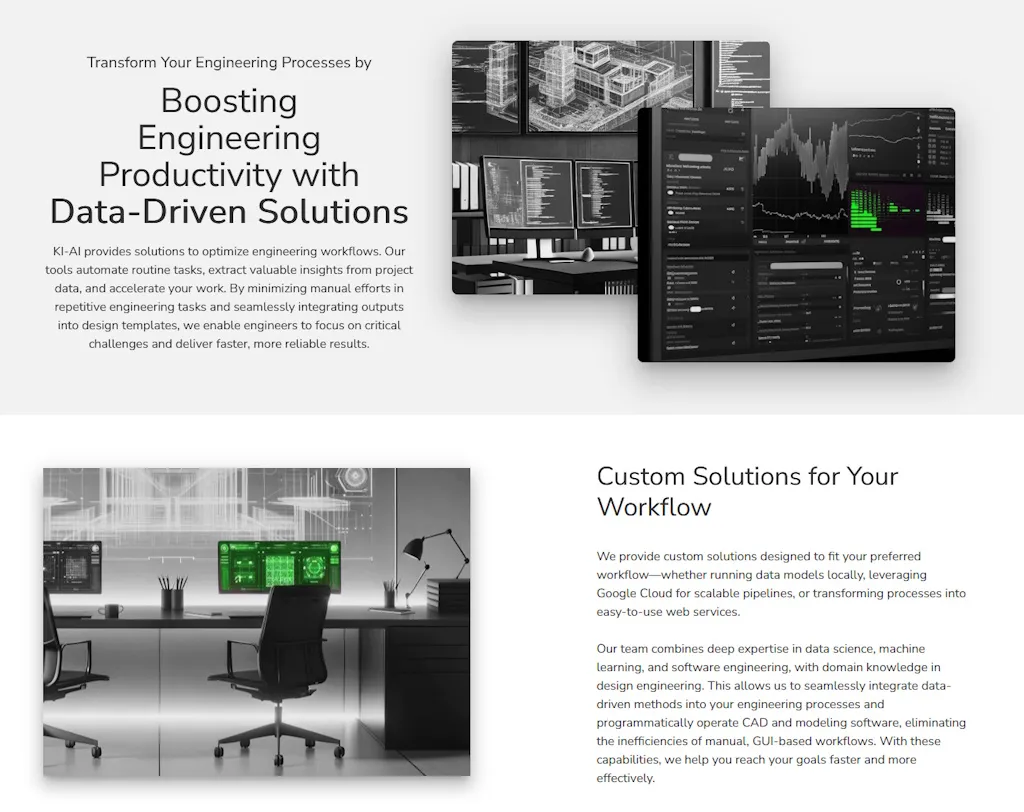
KI-AI provides solutions to optimize engineering workflows. Our tools automate routine tasks, surface the essentials from project data, and speed up the work. As manual effort in repetitive tasks decreases and outputs flow directly into design templates, engineers can focus on critical challenges and deliver faster, more reliable results.
Our current service offering includes a 3D model builder tool. Our BIM management tool uses parametric design to streamline 3D modeling tasks. With machine learning-based automation, teams can systematically leverage insights from previous projects, supporting better design decisions.
ML-powered engineering is central to our offering. Automating repetitive engineering tasks with machine learning reduces manual workload. Our data-driven approach and custom pipelines streamline the process, allowing engineers to focus on higher-level design challenges.
We also provide automated document processing. We automate document workflows by extracting data from images, PDFs, and other files using generative AI. New design documents are generated programmatically, ensuring accurate and efficient management with minimal manual effort.
Solutions are fitted to the workflow at hand: models can run locally, scalable pipelines can be built on Google Cloud, or processes can be turned into easy-to-use web services. Our team combines data science, machine learning, and software engineering with hands-on knowledge of design engineering. This brings data-driven methods into engineering processes and lets CAD and modeling software be operated programmatically, reducing the number of manual steps.
Looking for expert solutions? Discover Crestia's professional services today.